Applied, independent, and committed research
Our team regularly publishes in peer-reviewed journals, presents results at international scientific conferences (ERS, CPLF, Critical Care congresses, SFRMS, ATS), and collaborates on research projects with hospitals, universities, and industry. We always operate with an independent and demanding stance, including on sensitive topics such as device comparisons.
This scientific activity directly fuels our field work: the protocols we publish, the benches we design, and the models we develop are the same ones we use every day in our services.
One guiding principle: inform medical, technical, or industrial decisions with solid, reproducible, and clinically relevant data.
Improving ventilation at all ages and in every situation
Home NIV, pediatric ventilation, critical situations, complex pathologies. Our work covers a wide range of use cases.
All share one goal: improve the quality, effectiveness, and tolerance of ventilation while accounting for clinical realities.
We have contributed to many studies aiming to:
- Compare ventilator performance under simulated conditions (over 1,000 profiles tested on a bench),
- Assess the impact of leaks, settings, or interfaces on patient-ventilator synchrony,
- Identify predictors of well-tolerated NIV, from the start of home treatment,
- Optimize pediatric strategies by testing ventilator ability to detect very low volumes (up to 20 mL),
- Better understand respiratory pathologies, such as pulmonary fibrosis, through simulation of realistic and heterogeneous profiles.
This research, conducted with multiple university hospitals, rehabilitation centers, and industry partners, aims to guide clinical choices, support technological innovation, and above all propose approaches grounded in objective data.
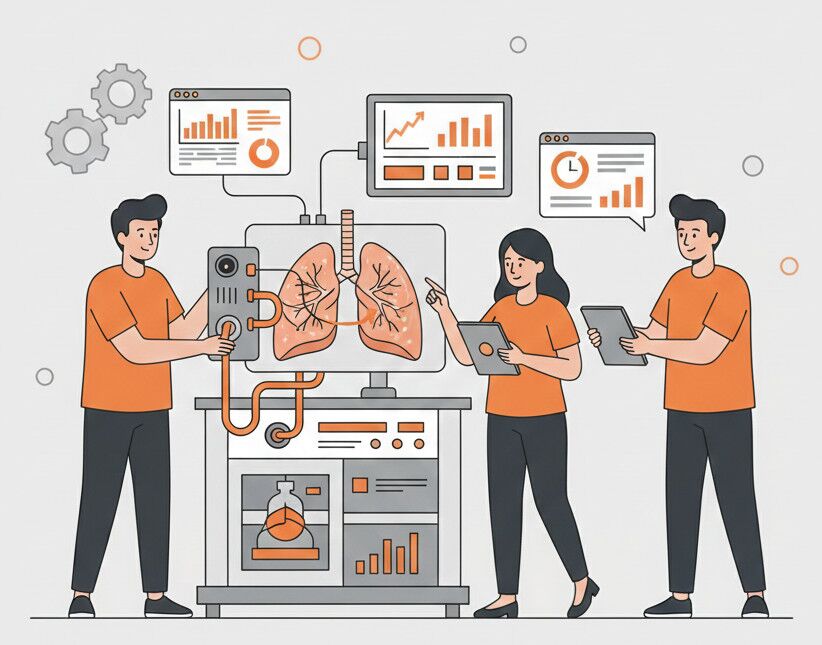
Simulate to care better: realistic models for robust devices
Better ventilation also means better understanding. And for that, we need to reproduce reality faithfully.
At KerNel Biomedical, we design physiological models and test benches capable of finely simulating clinical situations, including the most critical or variable. These simulation environments underpin several of our publications.
Projects include:
- The creation of a cardio-pulmonary simulator for cardiac arrest, capable of reproducing the effects of chest compressions on ventilation, a valuable tool for evaluating emergency devices (CPR).
- The study of mechanical imbalance in pulmonary fibrosis, using a test bench modeling compliance heterogeneity across lung regions.
- Use of the ASL 5000 artificial lung, combined with instrumented heads or complex profiles, to study specific cases: low efforts, asynchrony, Pendelluft, and more.
Our models are not just technical tools: they are engines of knowledge, enabling the understanding of subtle phenomena, comparing devices under fair conditions, and guiding the development of solutions better suited to patients.

Concrete results to guide clinical and industrial choices
Our publications do not stay in drawers. They inform, compare, and guide.
One of the key strengths of research at KerNel Biomedical is its ability to produce directly actionable results - for caregivers, engineers, buyers, or industry leaders.
Some examples of concrete applications:
- Comparative bench studies have helped to map ventilator performance across hundreds of configurations, guiding selection by patient profile.
- Our interface research has helped to document side effects linked to oronasal masks and propose criteria to improve comfort and efficacy.
- We contributed to the technical validation of innovative devices, such as low-oxygen-consumption CPAP (Bag-CPAP) or cough-assist devices, by comparing actual performance to displayed data.
- Our results are also used in telemedicine projects, respiratory rehabilitation, or software development, especially through real-world data processing.
This decidedly pragmatic approach strengthens the link between research, design, and use. It enables us to operate both upstream (design, strategy) and downstream (selection support, publication, dissemination).

Do you have a research project, a study to structure, or an article to publish?
Contact us